Table of Contents
ToggleFacebook Marketplace dropshipping is one of the most accessible and most misunderstood ecommerce models available today. In 2026, millions of buyers scroll Marketplace daily, hunting for deals on everything from ergonomic chairs to baby gear. And the biggest misconception? That it is dying. It is not. It has simply matured.
What began as a largely unmoderated classifieds platform has evolved into a trust-driven commerce ecosystem. One that rewards sellers who understand its algorithm, respect its policies, and fulfil orders with speed and precision. This guide covers everything from account setup and niche selection to advanced Facebook Marketplace SEO, automation tooling, AI strategies, and ban avoidance. Whether you are brand-new or already listing products, you will find something here that sharpens your competitive edge.
What Is Facebook Marketplace Dropshipping?
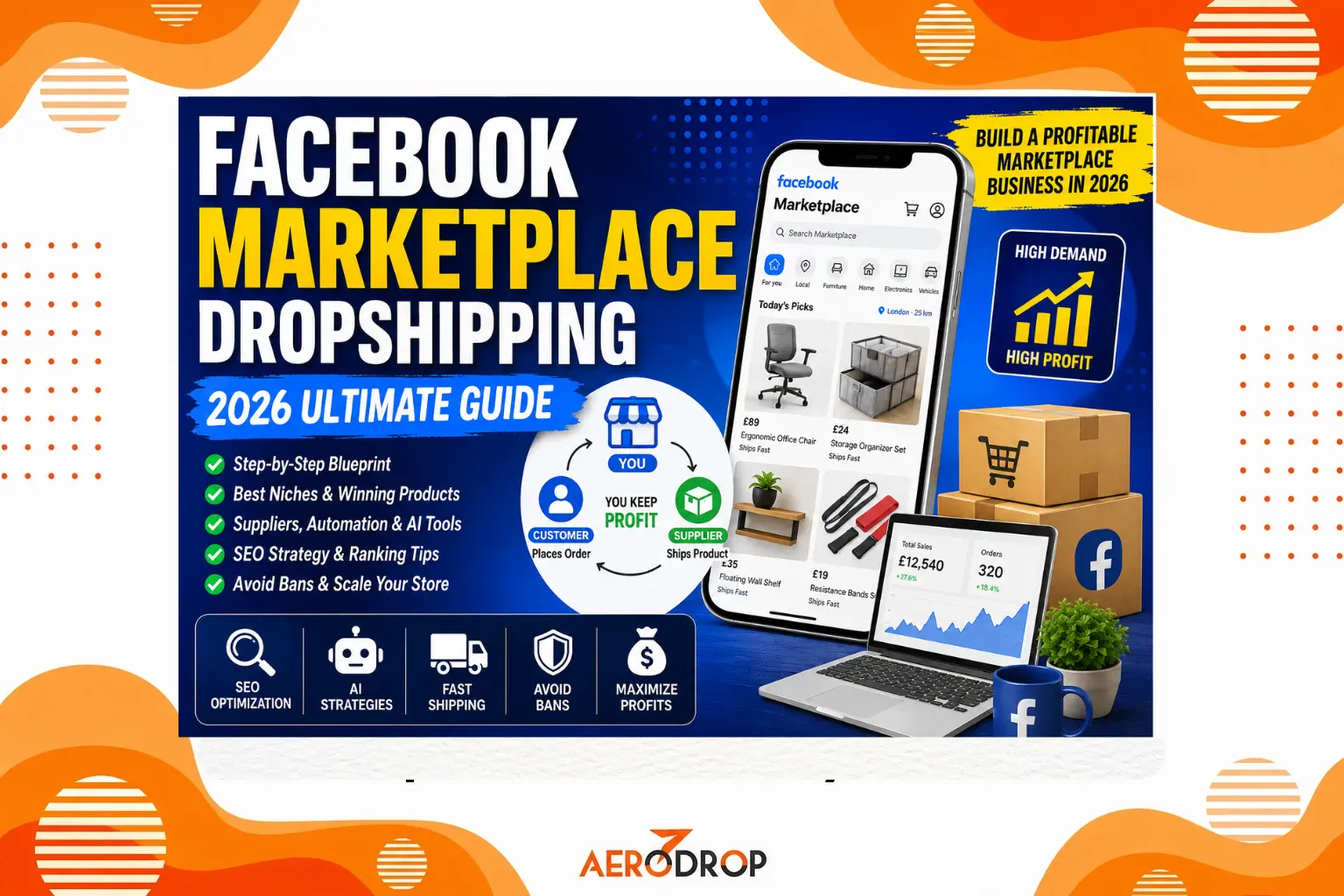
At its core, Facebook Marketplace dropshipping is a retail fulfilment method in which a seller lists products for sale on Marketplace without holding any physical inventory. When a buyer places an order, the seller purchases the item from a third-party supplier and has it shipped directly to the customer’s address. The seller keeps the margin between the retail price and the supplier’s cost.
Think Amazon, Walmart, AliExpress, or CJ Dropshipping as your backend fulfilment partners. You handle the listing and the customer relationship. They handle the warehouse and the shipping.
This model strips out the traditional overheads of ecommerce. No warehouse. No bulk inventory purchases. No complex logistics infrastructure. All you need is a Facebook account, a reliable supplier, and a workable system for managing orders and customer communication.
The Order Fulfilment Workflow
Customer orders on Marketplace. Seller purchases from supplier. Supplier ships to customer. Seller uploads tracking. Seller keeps the profit.
Unlike traditional ecommerce, there is no inventory risk. If a product stops selling, you simply stop listing it. This agility is what makes the model so compelling for newcomers and experienced operators alike. You are essentially connecting buyers on a high-traffic platform with products available at lower prices elsewhere.
Is Facebook Marketplace Dropshipping Allowed?
This is the question that stalls more aspiring sellers than any other. Let us address it plainly.
Facebook does not explicitly prohibit dropshipping in its Commerce Policies. What it does prohibit is misrepresentation. Listing products with misleading imagery, violating intellectual property rights, or failing to fulfil orders you accepted are the actual policy violations. Dropshipping as a fulfilment mechanism is, in practice, permitted, provided you adhere to shipping time expectations, upload valid tracking numbers promptly, and maintain honest product descriptions.
The nuance matters enormously here. Retail arbitrage from platforms like Amazon introduces a specific risk. Packages arriving in Amazon-branded boxes create buyer confusion and trigger dispute rates, which Facebook monitors closely.
Facebook expects sellers to meet delivery windows that align with what was communicated at the point of sale. Fail to do this consistently and the platform’s internal trust systems will begin to restrict your account’s visibility. Quietly. Without formal notification.
Common Reasons Accounts Get Restricted
Understanding the pitfalls is as important as understanding the opportunity. These are the most frequently cited causes of account restrictions among Marketplace sellers.
Late shipping or failure to upload tracking within the expected window. Delivery in Amazon, Walmart, or other retailer-branded packaging. High cancellation rates due to supplier stock-outs or fulfilment failures. Inconsistent tracking numbers that do not update in carrier systems. Excessive negative buyer feedback or unresolved disputes. Rapid listing volume spikes on newly created accounts, a pattern the algorithm flags as suspicious.
Navigating these risks is not merely about following rules. It is about engineering your operation to look like a trustworthy local seller, even when your fulfilment chain spans multiple intermediaries.
How Facebook Marketplace Algorithm Actually Works
This is where most dropshipping guides fall profoundly short. Understanding the Marketplace algorithm is not a peripheral concern. It is the central lever that determines whether your listings are seen by dozens of people or thousands.
Facebook’s ranking system is not a simple keyword-match engine. It is a multi-signal relevance and engagement model. Research from Meta’s own engineering teams confirms that the platform prioritises products based on a combination of relevance signals, engagement velocity, and buyer trust indicators. Each listing competes not just on price but on a composite trust and engagement score.
Top Marketplace Ranking Factors
The algorithm weighs the following signals when determining listing placement in search results and category feeds.
Keyword relevance is how closely your title and description match what buyers are searching for. Listing freshness means recently created or renewed listings receive a temporary visibility boost. Response time matters because sellers who reply to buyer enquiries quickly are surfaced more prominently. Profile trust score encompasses account age, completeness, and historical transaction record. Click-through rate signals relevance and earns more impressions when it is high. Saves and messages are direct engagement signals that tell the algorithm your listing is resonating. Shipping speed and tracking consistency factor into trust scoring. Image quality matters too, as high-resolution clean images outperform low-quality alternatives. Local intent matching is weighted heavily, especially for large or heavy items.
Facebook Marketplace SEO Optimisation
Most dropshippers treat their listing titles as an afterthought. This is a categorical error. Your title is the single highest-leverage element in your entire listing. It determines whether the algorithm surfaces you, and whether buyers click.
Title Formula: Keyword + Main Benefit + Feature + Colour or Variant
BAD: Office Chair
GOOD: Ergonomic Office Chair Lumbar Support Adjustable Armrests Black Ships Fast
BAD: Shelf
GOOD: Floating Wall Shelf Set Rustic Wood 3-Tier Bathroom Kitchen Storage Brown
Beyond the title, description optimisation is equally consequential. Lead with the primary keyword in the first sentence. Use short paragraphs. List key specifications in a scannable format. Avoid keyword stuffing, as Facebook’s system is sophisticated enough to penalise unnatural density. Ensure your chosen category is precise. Miscategorised listings suffer significant visibility penalties.
Is Facebook Marketplace Dropshipping Still Worth It in 2026?
The honest answer is yes. But with significant caveats.
The platform has undergone a fundamental philosophical shift. As industry observers have noted, Marketplace has moved from a volume-first to a trust-first model. Sellers who thrived in 2021 by listing hundreds of products from Amazon and relying on sheer listing density are finding that approach increasingly untenable.
What still works, and works exceptionally well, is a curated, quality-focused approach. Sellers who choose niches deliberately, source from fast-shipping suppliers, maintain impeccable fulfilment metrics, and treat their Marketplace presence as a genuine brand are generating consistent, scalable income.
The competitive landscape has thinned at the top. Many casual dropshippers have abandoned the channel after encountering restrictions. This leaves behind a market where serious operators face less saturation than on platforms like eBay or Etsy. Opportunity remains. It simply demands greater operational sophistication than it once did.
Pros and Cons of Facebook Marketplace Dropshipping
Pros
Free, high-intent organic traffic. Enormous buyer audience. Minimal startup capital required. No website or domain needed. Local buyer trust signals boost conversions. No listing fees on most product categories.
Cons
Account restrictions for policy infractions. Manual listing creation at scale is labour-intensive. Shipping timeline pressure from both buyers and the platform. Limited native automation compared to eBay or Etsy. Retail arbitrage packaging risks account health. Profit margins can be thin without niche discipline.
How to Start Facebook Marketplace Dropshipping Step-by-Step
Getting started correctly is not merely about creating a listing and hoping for the best. Every decision in the early stages compounds over time into either a sustainable operation or a perpetual restart cycle.
Step 1: Create and Warm Up Your Facebook Account
Account trust is foundational. A brand-new Facebook account with zero history that immediately begins listing dozens of products will trigger automated suspicion. The platform’s systems infer intent from behavioural patterns.
Spend two to four weeks engaging naturally with the platform before listing commercially. Join local buy-sell groups. Browse Marketplace. Respond to a few listings. Complete your profile thoroughly with a profile photo, location, and bio. Use your real name or a credible business name. This warming phase establishes a behavioural baseline that insulates your account from early-stage restrictions.
Once you begin listing, scale volume gradually. Start with five to ten listings and add incrementally over several weeks rather than uploading fifty products overnight.
Step 2: Choose a Profitable Niche
Niche selection is where many beginners make their most costly mistake. They choose based on personal interest rather than market evidence. The most consistently profitable niches on Facebook Marketplace share a common profile. Products that photograph well, ship within five to eight business days, carry a retail price between forty and three hundred pounds, and solve a tangible problem for a local buyer.
Categories that repeatedly surface in successful seller discussions include home decor and furnishings, storage and organisation solutions, fitness and wellness equipment, baby products and nursery accessories, pet accessories, and seasonal products.
Local-style products consistently outperform generic imports. Items that look like they could be sold by a neighbour rather than a faceless online retailer perform best on trust-driven platforms like Marketplace.
Step 3: Find Winning Products
Product research is an ongoing discipline, not a one-time exercise. The most effective sellers cross-reference multiple data sources before committing to a listing strategy.
TikTok Shop and TikTok organic content are valuable because viral products frequently migrate from TikTok to Marketplace search within weeks. Amazon Movers and Shakers provides real-time sales velocity data across categories. Active Marketplace competitor listings are worth studying by sorting by most relevant and analysing titles, prices, and engagement. Engagement checking helps identify listings with high save counts, which signal organic demand worth targeting.
The key metric you are hunting for is a product with demonstrated demand, a manageable level of competition, and a supplier who can fulfil within a timeframe Marketplace buyers will accept.
Step 4: Find Reliable Suppliers
Your supplier relationship is the operational backbone of your entire business. A supplier who ships late, provides inaccurate tracking, or frequently runs out of stock will systematically erode your account health regardless of how excellent your listings are.
AliExpress offers a wide product selection with variable shipping speeds. Filter for suppliers with AliExpress Standard Shipping and verified buyer reviews. CJ Dropshipping provides faster fulfillment than standard AliExpress and strong integration with automation tools. Amazon and Walmart offer fast domestic shipping but carry retail packaging risk. Use them only with caution. Zendrop is a curated supplier network with US fulfilment options, designed specifically for dropshippers. Local wholesale suppliers offer the highest trust signals and eliminate retail packaging risk entirely.
Prioritise suppliers who can provide carrier-traceable tracking numbers within twenty-four hours of order placement. This single criterion eliminates the majority of fulfilment risk.
Step 5: Create High-Converting Listings
Every listing is a micro landing page. Apply the following formula consistently.
Title: Keyword plus main benefit plus feature plus colour or variant. Description: lead keyword sentence, then key specs, then shipping info, then a trust signal. Price: competitive but not the lowest, as buyers on Marketplace associate rock-bottom prices with low quality. Photos: five to ten images with the first image being a clean product on a white or lifestyle background.
Urgency elements such as “Only 3 left” or “Ships within 24 hours” perform well when used honestly. Deceptive urgency backfires quickly on a platform where buyer reviews are visible to future customers.
Step 6: Handle Orders and Fulfilment
Once orders begin arriving, operational discipline becomes paramount. Place supplier orders within hours of receiving a buyer payment. Upload tracking numbers to Marketplace as soon as they are available, even if the carrier has not yet scanned the package. Communicate proactively with buyers if any delay is anticipated.
For refunds, process them swiftly and without friction. A resolved dispute costs you money but protects your account standing. A contested dispute that escalates costs you more in both monetary terms and algorithmic trust score.
Best Product Categories for Facebook Marketplace
Not all niches perform equally. The following categories consistently generate strong results for Marketplace dropshippers, based on demand patterns, margin viability, and buyer psychology.
Home Improvement and Tools
Practical home improvement products such as drill organisers, LED lighting strips, and weatherstripping kits attract buyers with immediate, purpose-driven intent. These are not impulse buys. They are solutions to specific problems. Conversion rates in this category tend to be above average.
Storage and Organisation
The organisation and declutter movement has produced a durable, multi-year demand surge for storage solutions. From modular closet systems to under-bed boxes and kitchen drawer organisers, this category carries broad demographic appeal and strong repeat-purchase potential.
Furniture and Home Furnishings
High average order value, strong local buyer intent, and good margin potential make furniture one of the most lucrative Marketplace categories. Lightweight flat-pack items such as computer desks, accent chairs, and bookshelves represent the ideal intersection of demand and practical fulfilment logistics.
Pet Accessories
Pet owners are emotionally invested buyers who prioritise quality over price. Premium pet products such as orthopaedic dog beds, interactive cat toys, and grooming tools carry healthy margins and generate repeat engagement from loyal buyer segments.
Fitness Equipment
Resistance bands, yoga blocks, portable pull-up bars, and ab rollers remain perennial bestsellers. The sub-seventy-pound price point for most of these products sits perfectly within Marketplace’s impulse-adjacent buyer psychology.
Best Suppliers for Facebook Marketplace Dropshipping
AliExpress is best for a wide product range and niche items. Shipping typically takes seven to twenty days. Risk level is medium.
CJ Dropshipping is best for faster fulfillment and automation integration. Shipping typically takes five to twelve days. Risk level is low to medium.
Amazon is best for domestic speed and buyer trust. Shipping typically takes two to five days. Risk level is high due to branded packaging.
Walmart is best for US domestic fulfillment with no membership requirement. Shipping typically takes three to seven days. Risk level is high due to branded packaging.
Temu is best for ultra-low price points. Shipping typically takes eight to eighteen days. Risk level is medium to high.
Zendrop is best for curated, dropship-optimised fulfilment. Shipping typically takes five to ten days for US orders. Risk level is low.
Best Automation Tools for Facebook Marketplace
Manual management of a high-volume Marketplace operation is operationally unsustainable. The following tools address specific friction points in the dropshipping workflow.
AutoDS
AutoDS offers comprehensive automation including product importing, price monitoring, automatic order fulfilment, and tracking number upload. Its Marketplace integration is among the most mature in the ecosystem, with features specifically designed for the Marketplace fulfilment workflow.
DSM Tool
DSM Tool specialises in listing management and repricing automation. Its bulk-listing functionality makes it particularly valuable for sellers managing catalogues across multiple categories. The platform includes competitor price monitoring and automated price adjustment rules.
SKU Grid
SKU Grid provides real-time inventory synchronisation between your supplier sources and your active listings. When a product goes out of stock at the supplier level, SKU Grid can automatically end or pause the corresponding Marketplace listing. This prevents overselling and the cancellations that damage account health.
Zik Analytics
Primarily a research tool, Zik Analytics helps sellers identify high-demand, low-competition products by analysing sell-through rates, competition density, and price positioning across multiple platforms simultaneously.
Facebook Marketplace SEO Strategy
Marketplace SEO is perhaps the most underutilised lever available to dropshippers. The sellers who treat their listings with the same keyword discipline they would apply to a Google-optimised product page consistently outperform those who rely on intuitive titling.
Keyword Research for Marketplace Listings
Marketplace’s search autocomplete is your most immediate research tool. Begin typing a product type and observe the suggested completions. These reflect real buyer search behaviour on the platform. Note the specific modifiers buyers append: colours, sizes, materials, brand names, use-case descriptors.
Supplement autocomplete research with competitor title analysis. Identify the top three to five listings in your target category and audit their titles for keyword patterns. Then layer in local modifiers where appropriate, as Marketplace heavily weights geographic relevance.
Buyer intent keywords should be prioritised in your title and the opening line of your description. Phrases like “ready to ship”, “brand new”, and “fast delivery” function as intent amplifiers that signal purchase readiness rather than casual browsing.
CTR Optimisation
Click-through rate is both a metric and a ranking signal. Improving your CTR compounds over time. More clicks generate more engagement data, which the algorithm uses to serve your listing to more buyers.
The primary lever for CTR is your thumbnail image. Use a high-contrast, clean product photo as your primary image. Avoid cluttered backgrounds, watermarks, or images that appear cropped from a retailer’s product page. Lifestyle images showing the product in a realistic domestic setting typically outperform pure white-background shots on Marketplace.
Pricing psychology is equally important. A price of 49.99 outperforms 50 not because of the one-penny difference but because of how the brain categorises the price bracket. Prices that end in .95 or .97 tend to signal value-consciousness rather than budget compromise.
Listing Freshness Strategy
Facebook Marketplace applies a freshness weighting to listings. Newer and recently renewed listings receive a temporary visibility boost in both search results and category feeds. This is observable behaviour that experienced sellers systematically exploit.
Renew your listings every five to seven days. The renewal process takes seconds and resets the freshness clock, effectively relisting the product without creating a duplicate. For high-performing listings, this single tactic can meaningfully extend their productive lifespan in the algorithm’s favour.
Engagement Optimisation
Response speed is a direct ranking input. Marketplace’s algorithm measures how quickly you respond to buyer messages and incorporates this as a trust signal. Aim to respond within sixty minutes during active hours. Use saved message templates for common enquiries including shipping timelines, condition descriptions, and availability confirmations. This maintains speed without sacrificing personalisation.
Encourage buyers to leave ratings after successful transactions. Your profile’s rating aggregate contributes to the trust signals the algorithm assigns to your listings. A seller with a 4.9-star rating from fifty transactions occupies a structurally superior algorithmic position to an unrated or low-rated competitor at the same price point.
Common Facebook Marketplace Dropshipping Mistakes
Listing oversaturated products without meaningful differentiation. If everyone is selling the same LED strip lights at the same price, the listing pool is too competitive for a new account to break through.
Choosing suppliers based solely on price rather than shipping speed and tracking quality.
Using misleading or stolen product photos. Marketplace buyers are savvy. A mismatch between imagery and the delivered product is the fastest path to disputes.
Neglecting buyer communication. Unanswered messages are both a customer service failure and an algorithmic penalty.
Aggressive automation on new accounts. Deploying bulk-listing tools before establishing account trust accelerates restriction risk considerably.
Ignoring account health metrics. Most sellers only examine their metrics after a restriction, not before. By then it is often too late to course-correct without a full account reset.
How to Avoid Facebook Marketplace Bans
Account health management is a proactive, ongoing discipline. The sellers who avoid restrictions are not those who were lucky. They are those who engineered their operations to stay well within Facebook’s tolerance boundaries at every stage of scaling.
Account Warming
Warming a new account before commercial activity is non-negotiable. Establish a minimum of two to four weeks of natural platform behaviour before listing products commercially. The investment in time here pays dividends in account longevity.
Volume Pacing
Listing volume should scale proportionally with your account’s track record. Begin with a small catalogue of ten to twenty listings and expand incrementally. Sudden spikes in listing volume on accounts without established trading history are flagged by Facebook’s automated systems as potentially inauthentic behaviour.
Shipping Consistency
Fulfil every order within the window you have communicated to the buyer. If your supplier requires seven to ten days, do not promise five. Under-promise and over-deliver. Consistent on-time fulfilment is the single most powerful account health maintenance strategy available to Marketplace sellers.
Avoiding Suspicious Behaviour Patterns
Do not list identical products across multiple accounts. Do not use VPNs to obscure your location if it creates inconsistencies in your profile data. Avoid listing products in categories that require compliance verification unless you can genuinely satisfy those requirements. Be consistent in your pricing behaviour, as extreme price changes on established listings can trigger a review.
Realistic Profit Expectations
Transparency here is essential. Facebook Marketplace dropshipping is not a path to passive income in the conventional sense, particularly in the early stages. It is a business that rewards consistent operational effort with scalable returns over time.
Beginner Seller (Months 1 to 3)
In the initial phase, the realistic expectation is modest. Two hundred to eight hundred pounds per month in net profit from a catalogue of twenty to fifty listings. The primary focus should be on learning. Identifying which products convert, refining your listing approach, and building account trust rather than maximising immediate revenue.
Intermediate Seller (Months 4 to 12)
With established account standing, a tested product catalogue, and improving operational efficiency, intermediate sellers typically generate between fifteen hundred and five thousand pounds per month. Automation tools begin to justify their cost at this stage, and niche specialisation compounds into a recognisable seller identity on the platform.
Scaled Seller (Year Two and Beyond)
Sellers who have systematically built account trust, refined supplier relationships, and deployed effective automation report monthly net revenues of eight thousand to twenty-five thousand pounds and above. At this scale, the operation resembles a small ecommerce business rather than a side hustle, requiring proportionate time investment in management and supplier relationship maintenance.
AI Strategies for Facebook Marketplace Dropshipping
Artificial intelligence is rapidly becoming a genuine operational advantage for Marketplace sellers who adopt it early. The following applications are both practical and accessible today.
AI Listing Generation
Tools built on large language models can generate SEO-optimised listing titles and descriptions from a product specification in seconds. Rather than spending hours crafting individual listings, sellers can generate, review, and adapt AI-produced copy across an entire catalogue in a fraction of the time. This is particularly transformative for sellers managing catalogues of one hundred listings or more.
AI Product Research
AI-powered trend analysis tools can surface emerging product opportunities weeks before they saturate organic search or Marketplace search results. Early positioning in a trending micro-niche provides a meaningful first-mover advantage that compounds as the trend matures.
AI Pricing Optimisation
Dynamic repricing tools that incorporate machine learning can adjust your listing prices in response to competitor price movements, demand signals, and time-of-day patterns. This maximises margin without manual intervention. Technology once available only to enterprise retailers is now accessible to independent Marketplace sellers through tools like DSM Tool and AutoDS.
AI Image Enhancement
Background removal, image sharpening, and lifestyle image generation are all powered by accessible AI tools. They allow sellers to produce professional product imagery without photography equipment or design skills. High-quality images are the single highest-impact listing variable after the title, making this a high-return application of AI tooling.
AI Customer Support
AI-assisted message templates and chatbot integrations can handle the high volume of repetitive enquiries that consume disproportionate time at scale. Questions about shipping timelines, product dimensions, and availability are ideal candidates for AI-assisted responses. Maintaining fast response times across a large catalogue becomes operationally feasible with these systems in place.
Facebook Marketplace Dropshipping FAQs
Is Facebook Marketplace dropshipping legal?
Yes. Dropshipping as a fulfilment model is legal in most jurisdictions. Facebook does not prohibit the model in its Commerce Policies, provided you fulfil orders honestly, ship within the communicated timeframe, and do not misrepresent product origins. Always review the current Facebook Commerce Policies for any updates.
Can you automate Facebook Marketplace?
Partial automation is achievable and widely practised. Tools like AutoDS, DSM Tool, and SKU Grid can automate listing creation, inventory synchronisation, repricing, and tracking uploads. Full end-to-end automation, including account interactions and buyer messaging, carries policy risk and is not advisable. Treat automation as an efficiency multiplier, not an account-management substitute.
What products sell best on Facebook Marketplace?
Home furnishings, storage and organisation products, fitness equipment, pet accessories, and seasonal home decor consistently generate strong results. Products priced between thirty-five and two hundred and fifty pounds with a clear demonstrable function and fast shipping availability tend to convert at the highest rates.
Is dropshipping dead on Facebook?
No. The model has evolved, but it is decidedly not dead. Sellers who adapted to the platform’s trust-first orientation are generating meaningful, scalable income in 2026. The sellers who failed were those who could not or would not adapt their practices beyond the volume-first playbook.
Can beginners start Facebook Marketplace dropshipping?
Absolutely. The barrier to entry is genuinely low. A Facebook account, a reliable supplier, and the time to create your initial listings are all that is technically required. The more consequential requirement is the patience to scale gradually and build account trust before chasing high listing volumes.
Do you need a website to dropship on Facebook Marketplace?
No. Facebook Marketplace operates as a self-contained commerce platform. There is no requirement for an external website, payment processor, or ecommerce platform. All transactions, messaging, and review functionality occur within the Facebook ecosystem.
How do you avoid bans on Facebook Marketplace?
The primary protective measures are warming your account before commercial activity, scaling listing volume gradually, fulfilling every order within the communicated timeframe, providing valid tracking numbers promptly, using supplier partners whose packaging does not expose your fulfilment model to buyers, and maintaining responsive professional communication with buyers at all times.
How much money can you make dropshipping on Facebook Marketplace?
Income potential scales significantly with operational sophistication. Beginners in months one through three typically net two hundred to eight hundred pounds monthly. Established sellers with twelve or more months of account history commonly report five thousand to fifteen thousand pounds per month. Exceptional performers with highly systematised operations exceed these figures, though such outcomes require commensurate time and capital investment.
Final Thoughts
Facebook Marketplace dropshipping in 2026 is a genuine business opportunity. Not a passive income myth, not a dying model, and not a shortcut. It is a merit-based commerce environment that rewards sellers who understand its algorithmic mechanics, respect its trust infrastructure, and treat buyers as valued customers rather than transaction numbers.
The sellers who will succeed over the next several years are those who adopt a local-first mindset. Presenting themselves as credible, responsive, community-embedded sellers even when their fulfilment chain is global. They invest in understanding the algorithm before blaming it, in choosing suppliers based on reliability rather than price alone, and in building account trust as deliberately as they build their product catalogue.
Speed and trust are not optional extras in this model. They are the foundational infrastructure. Fulfil fast, communicate clearly, optimise relentlessly, and Marketplace will reward the investment.
Ready to launch? Start with one niche, five products, and a supplier you have vetted for shipping speed. Build trust before you build volume. That is the competitive advantage most beginners overlook.