Table of Contents
ToggleHow Top Dropshippers Secretly Cut Product Costs by 50%
If you are a dropshipper or Shopify store owner, you have probably asked yourself the same question at some point. How are some stores able to sell at competitive prices, ship faster, and still protect their margins while everyone else struggles with rising costs?
The honest answer is that top dropshippers usually are not using one secret trick. They are using a better system. They source smarter, negotiate earlier, simplify fulfillment, and remove hidden costs that most beginners never track properly. That is where the real savings come from.
This guide is for store owners who want to understand how experienced dropshippers reduce product costs without cutting corners on quality or customer experience. I am not going to sell you fantasy tactics or recycled advice. Instead, I will walk you through the real levers that affect cost, where savings actually come from, and how you can apply the same thinking to your own store.
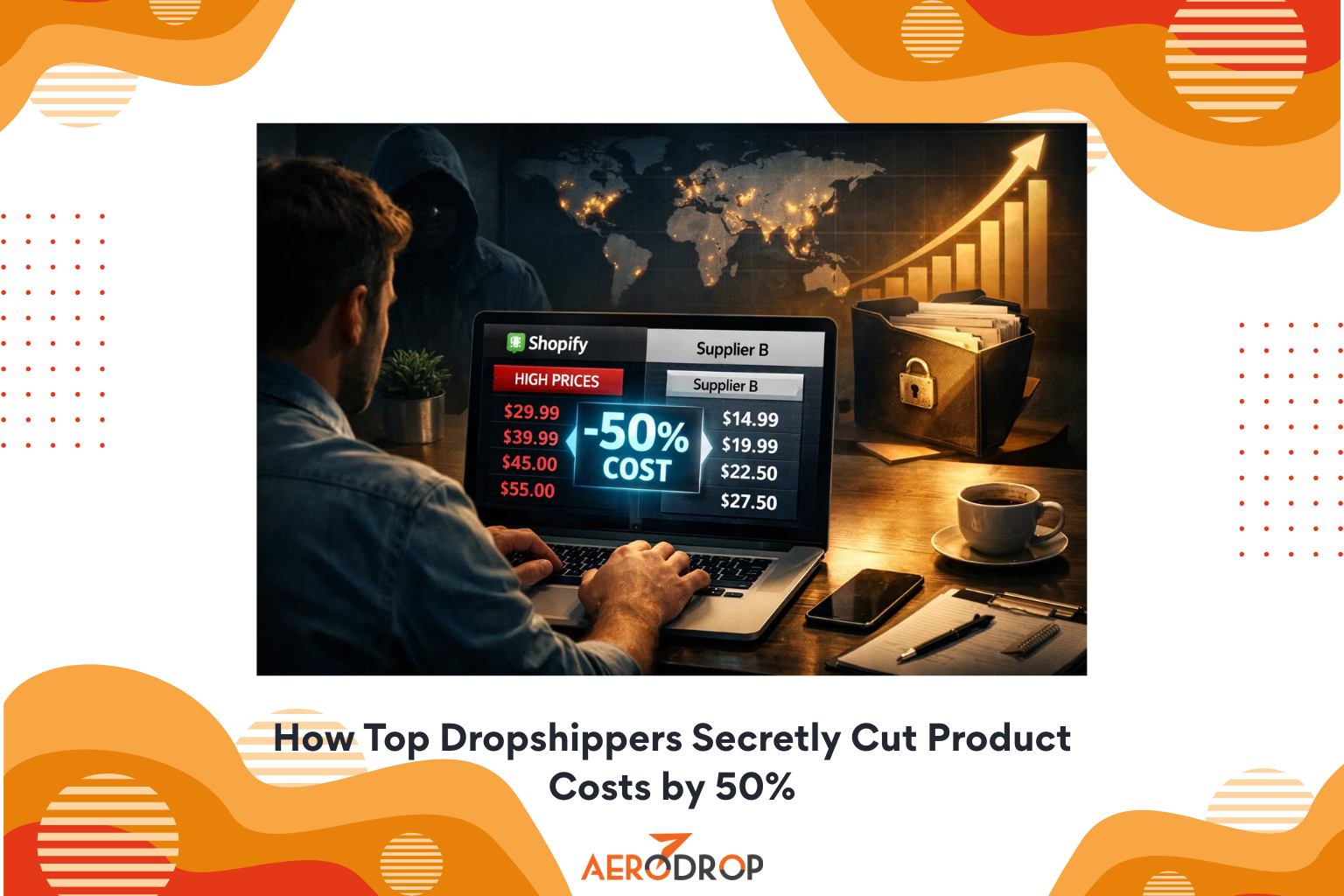
It is also worth saying this clearly. Cutting product costs by 50% is possible in some cases, but it is not automatic and it is not universal. The biggest reductions usually happen when a seller moves from retail-style sourcing to structured supplier relationships, better shipping arrangements, and more efficient fulfillment. Shopify defines product sourcing as the process of finding and acquiring products to sell, whether through manufacturers, wholesalers, or dropshipping suppliers, which is exactly where these cost improvements begin. (Shopify)
Why Most Dropshippers Overpay in the First Place
Most beginners overpay because they treat sourcing like product browsing. They pick a supplier, import a product, test a few ads, and focus almost entirely on selling price. What they often miss is that their real cost is not just the unit price. It is the unit price plus shipping, plus payment fees, plus refund risk, plus the time cost of manual work, plus the margin lost when delivery is too slow.
That is one reason dropshipping looks cheap to start but becomes harder to scale. Shopify notes that dropshipping removes costs like warehouse storage and unsold inventory, but it also comes with reduced control over the customer experience. That tradeoff matters because weak supplier control often shows up later as higher effective costs. (Shopify)
I have seen this pattern many times. A store owner thinks they are buying a product for $12, but after shipping, app fees, payment processing, and customer support time, the real cost feels much closer to $18 or $20. At that point, even a small sourcing improvement makes a big difference.
The First Real Move is Switching from Retail Sourcing to Supplier Sourcing
This is where top dropshippers start separating themselves from the crowd.
Instead of buying from the same public listings that thousands of other sellers use, they move closer to the source. That can mean working with a sourcing agent, using a supplier directory, requesting direct quotes, or moving selected winners to wholesale or semi-private supply arrangements. Shopify’s supplier guidance consistently points merchants toward structured sourcing and supplier comparison rather than relying on a single public marketplace listing. (Shopify)
In practical terms, this matters because public marketplace pricing often includes convenience pricing. You are paying for easy access, not just for the product. Once you have sales data, customer feedback, and proof that a product moves, you are in a better position to request better terms.
This is one of the least talked about shifts in beginner content. Early on, marketplaces help you move fast. Later, they often become the reason your margins stay thin.
Top Sellers Negotiate Before They Scale
A lot of store owners wait too long to negotiate. They assume negotiation is only for large brands or bulk importers. In reality, suppliers often expect negotiation, especially when they see repeat potential.
Alibaba’s own supplier-side guidance says MOQ is often a starting point for negotiation, not a fixed wall, and it highlights tactics like trial orders, growth plans, and quarterly reorder commitments to secure more flexible terms. (Alibaba.com Seller Central)
That matters for dropshippers because negotiation is not only about asking for a lower unit price. It can also include better shipping rates, bundled packaging, lower trial MOQs, faster lead times, custom inserts, or better payment terms. Sometimes the price barely changes, but the total landed cost drops because shipping and handling improve.
In my experience, the best negotiations happen when you stop sounding like a casual browser and start sounding like a serious operator. Share your expected order volume. Show your store link. Explain that you want to test first, then scale. Suppliers are much more open when they believe there is repeat business on the table.
They Reduce Shipping Cost by Changing Fulfillment Logic
Here is another place where strong stores quietly win.
They do not just chase a lower product price. They rethink where the product ships from, how orders are routed, and whether fulfillment can happen closer to the customer. McKinsey reports that consumers continue to raise the bar on delivery speed and reliability, and its 2025 delivery research found that most customers are willing to wait a few days when shipping is free, but expectations still center on dependable, reasonably fast delivery. (McKinsey & Company)
That means slower shipping is not just a customer experience problem. It is a cost problem too. Slow delivery tends to create more support tickets, more refund requests, and weaker conversion rates.
Shopify’s warehouse and fulfillment guidance explains that fulfillment facilities act as active centers for receiving, picking, packing, and shipping. For growing sellers, moving inventory or fulfillment closer to customers can reduce shipping friction and improve delivery performance. (Shopify)
Top dropshippers use this logic in different ways. Some source from suppliers with local warehouses. Some move winning products into faster fulfillment channels. Some use agents or platforms that consolidate sourcing and shipping into one workflow. The point is the same. Product cost is never just product cost. Shipping strategy changes margin.
They Know That Bulk Leverage Does Not Always Mean Huge Inventory Risk
When people hear bulk purchasing, they often imagine ordering thousands of units and tying up cash. That is not always how experienced operators do it.
The real advantage of volume is leverage. Economies of scale reduce per-unit cost because fixed costs and operational overhead are spread across more output, and buying in larger quantities often improves supplier bargaining power. (Corporate Finance Institute)
Now, for a dropshipper, that does not always mean going fully wholesale on day one. It can mean testing a product through dropshipping, validating demand, then moving only your best sellers into a deeper supply arrangement. It can also mean negotiating price breaks at smaller thresholds than you expected. Alibaba’s recent MOQ guidance even outlines configurations such as 100 to 250 pieces for growing brands, showing that better pricing is not reserved only for very large orders. (Alibaba.com Seller Central)
This is one of the smartest ways to improve margins without gambling on every product in your catalog.
They Remove Hidden Costs Through Automation
A lot of merchants think automation is mainly about saving time. It does save time, but it also protects margin.
Manual sourcing and order placement create mistakes. Wrong variants get sent. Orders are delayed. Tracking updates are missed. Staff hours disappear into repetitive tasks. BigCommerce notes that automation and third-party integrations are becoming standard in supplier discovery and purchasing workflows because they speed up operations and reduce friction. (BigCommerce)
That lines up with what most experienced operators already know. The more orders you process manually, the more your effective cost rises, even if your sticker price looks fine on paper.
This is why seasoned dropshippers care so much about synchronized product import, automated fulfillment, pricing control, and a central dashboard. These are not just convenience features. They are margin protection tools.
The Stores with the Best Margins Build Supplier Relationships, Not One-off Transactions
This is probably the biggest mindset shift of all.
Weak stores treat suppliers like anonymous vendors. Strong stores treat them like operating partners. They check response times, consistency, packaging quality, lead times, and problem resolution. They reward reliable suppliers with repeat orders. Over time, that relationship often produces better pricing, better priority, and more flexibility when something goes wrong.
Shopify’s dropshipping supplier guidance emphasizes comparing suppliers and using directories or apps to identify better-fit partners instead of blindly depending on the first listing you see. (Shopify)
If you want better cost structure, better reliability usually comes first. Reliable suppliers lower the hidden costs that destroy margins.
A Realistic Way to Apply This to Your Own Store
If you want to cut product costs meaningfully, start with one winning product, not your entire catalog.
Review your current total landed cost. Then compare it against a direct supplier quote, a sourcing platform, or a supplier agent. Ask what happens to price if you commit to repeat orders. Ask whether shipping can be improved. Ask whether packaging or branding can be bundled. Ask whether your current order flow can be automated.
That is how top dropshippers do it. They do not guess. They audit, compare, and negotiate.
A 50% cost reduction will not happen on every item. But when sellers stack lower sourcing costs, improved shipping, fewer manual errors, and better supplier terms, the total savings can become significant. That is the real story behind the headline.
Final Step: How AeroDrop Helps You Grow Your Online Business
If you want to apply these lessons without stitching together multiple tools, AeroDrop is built around the exact areas that usually affect dropshipping margin.
Based on the product materials, AeroDrop is designed as an all-in-one Shopify dropshipping platform with handpicked products, one-click import, real-time fulfillment tracking, and a beginner-friendly setup. The product profile also highlights smarter sourcing, in-app editing, order management from one dashboard, custom branding options, and real-time performance insights.
That matters because margin growth usually comes from operational improvements, not just from chasing the cheapest listing online. With AeroDrop, store owners can reduce sourcing friction, automate fulfillment, manage products from one place, and improve decision-making with live performance visibility. The platform also highlights faster shipping, support for custom packaging, and support designed to help Shopify merchants scale with less backend stress.
So if your goal is to grow beyond basic marketplace dropshipping, AeroDrop helps by simplifying the parts of the business that most often eat margin. You spend less time handling manual tasks, gain more control over sourcing and fulfillment, and create a stronger foundation for scaling your store profitably.